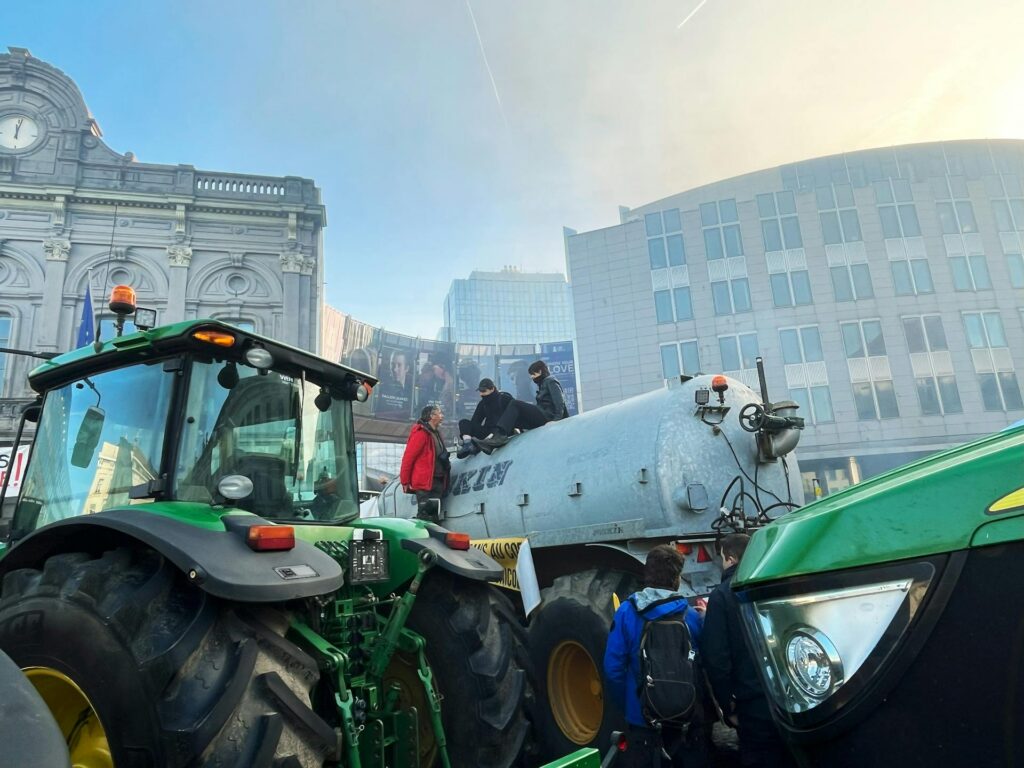
Farmers are protesting in Brussels. Here’s how Brussels can do better for them.
While farmers are understandably protesting in Brussels to defend their livelihoods, the EU must seize the opportunity to harness the diversification of biomass uses as a lever to address their concerns, especially at a time when budgets are tight and the future Common Agricultural Policy budget is expected to shrink. The equation is simple: if farming is not profitable, farming will disappear in the EU.
A recent study by the Nova Institute confirms that diversification of crop uses is essential for a competitive and resilient agricultural sector. It strengthens food security, contributes to climate change mitigation, supports biodiversity and enables the production of bioenergy and bio-based materials. In this context, bioethanol production plays a pivotal role providing an additional profitable market for crops and, when they are transformed into foodstuffs, their wastes and residues. These non-food outlets act as market stabilizers, securing agricultural output, outlets and prices ultimately safeguarding farmers’ income and food production.
Other regions have long understood this. In Brazil, ethanol blending mandates are adjusted up or down based on crop yields. In the US, biofuels policy and the BioPreferred Program have successfully supported farmers’ revenue for over five decades.
But the strategic benefits of diversification go further. Encouraging farmers to sustainably cultivate land is the most cost-effective way to build a dynamic food reserve, as advocated by global hunger experts and highlighted in the Nova Institute study. Unlike static reserves that sit in storage until a crisis hits, dynamic reserves are actively used to defossilize, reduce oil addiction and cut air pollution while remaining available in times of need.
This approach proved its worth during COVID-19 when ethanol originally destined for fuel was redirected to produce hand sanitizers and supply hospitals to mitigate the pandemic. Without EU ethanol production, Europe would have faced a desperate scramble on the global market.
Without the right policy support and without ending the constant discrimination against sustainable crop-based biofuels in EU legislation — in the ReFuelEU or the recently proposed revision of CO2 standards for cars and vans Regulation, to name just two examples – investors will abandon EU ethanol production.
EU trade deals like the one with Mercosur pose yet another threat to EU ethanol production and therefore to EU agriculture, as ethanol imports surge, domestic production disappears and EU farmers lose a strategic and domestic outlet.
Today, as farmers fight again to protect their livelihood, we urge decision-makers to view the diversification of biomass uses for what it truly is: a strategic opportunity to tackle multiple challenges such as food and energy security, defossilization and the preservation of farmers’ livelihoods and vital work. Supporting Europe’s agriculture means ensuring fairness, competitiveness and long-term sustainability. The people who feed Europe must not be asked to bear the cost of the lack of diversification of biomass or an unbalanced trade agreement.
-ends-